
5 Things Most Women Assume About Their Body Before Pregnancy That Aren't True
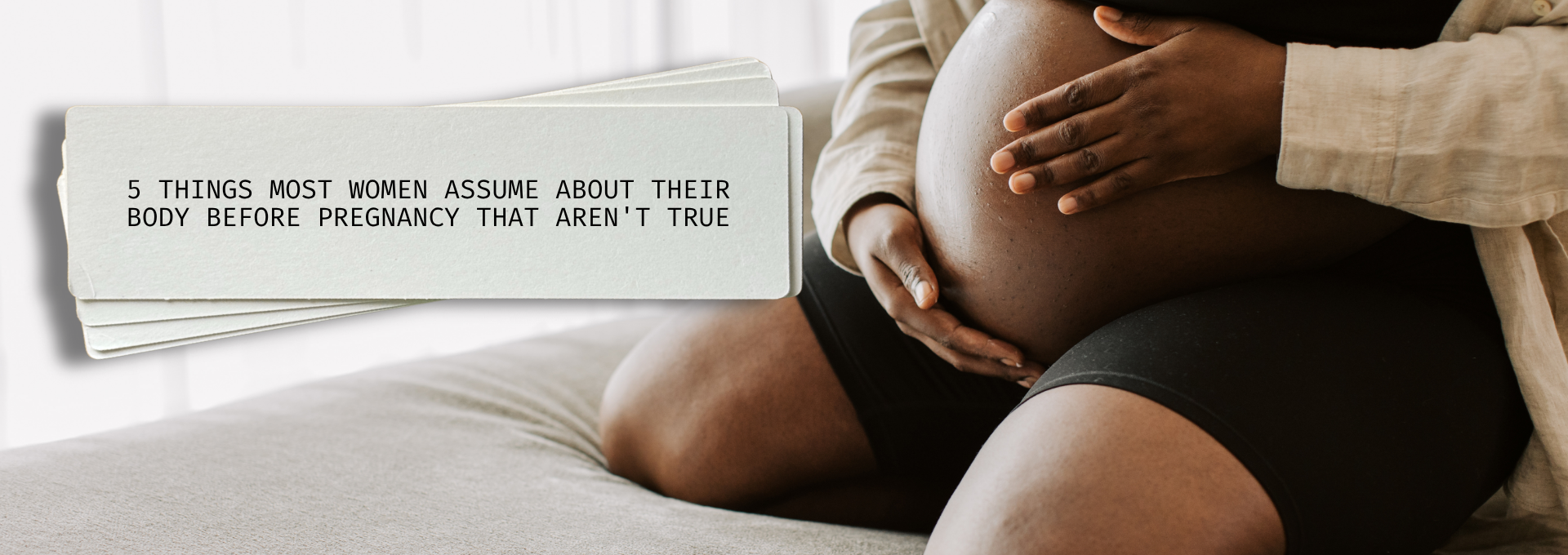
You eat well. You exercise. You feel fine. Your last checkup came back clean.
So when pregnancy enters the conversation, the assumption is straightforward: my body is ready.
And it might be. But "probably fine" and "confirmed optimized" are two very different starting points.
Here are five assumptions that lead women into conception with less information than they realize.
1. "My annual physical would catch anything important."
Your annual physical is designed to screen for disease. It flags diabetes, anemia, thyroid dysfunction at clinical levels, kidney and liver issues. It's built to catch what's broken.
It's not built to assess what's optimal for pregnancy.
A standard panel checks TSH but not how well your thyroid converts to the active hormone your cells use. It checks hemoglobin but not ferritin, the stored iron your body draws from during placental development. It checks fasting glucose but not fasting insulin, which reveals metabolic patterns that affect the ovarian environment months before conception.
The gap between "nothing's wrong" and "everything's optimized" is exactly where preventable preconception issues live.
2. "I'm healthy, so my hormones are fine."
Health and hormonal optimization aren't the same thing.
You can feel completely normal with a progesterone level that's too low to build the uterine lining implantation requires. You can have zero symptoms with a thyroid that's technically in range but not in the tighter window that supports early fetal development. You can have steady energy and a regular cycle while fasting insulin quietly creates oxidative stress inside your ovarian follicles.
Hormones don't always announce when they're suboptimal. That's what makes preconception testing valuable. It catches what you can't feel.
3. "My prenatal vitamin covers everything I need."
A prenatal is a baseline, not a personalized plan. It's formulated for broad minimums across a wide population. It doesn't know your starting levels, and it can't close a significant gap on its own.
If your ferritin is already low, the iron in a standard prenatal may not be enough to build adequate stores before pregnancy demands them. If your vitamin D is sitting below optimal, 400 to 1,000 IU daily may not move the number in time. If you have a common genetic variant that reduces your ability to convert folic acid into the active form your body uses, you may need methylfolate instead and never know it without testing.
Supplementing without testing is guessing. Testing first means every pill you take is doing something specific for your body.
4. "Fertility only matters once I'm actively trying."
This one might be the most costly assumption of all.
Every egg you ovulate goes through its final 90 days of maturation before it's released. During that window, the hormonal, metabolic, and nutritional environment of your body shapes that egg's cellular energy function, DNA integrity, and overall viability.
By the time you're tracking ovulation and timing intercourse, the egg you're working with was already 90 days in the making. The window to influence its quality has already closed.
That's why the 3-6 months before conception aren't a waiting period. They're the active preparation period. The women who use that time to optimize have a different biological starting point than the women who begin thinking about it on month one of trying.
5. "If something were wrong, I'd have symptoms."
Some of the most impactful preconception findings come with no symptoms at all.
A thyroid conversion issue doesn't always cause fatigue or weight gain. Low luteal phase progesterone doesn't always produce obvious PMS symptoms. Subclinical insulin resistance doesn't always show up as weight changes or cravings. Vitamin D insufficiency doesn't always feel like anything.
These patterns are common, correctable, and invisible without the right labs at the right time. The women who catch them aren't sicker than anyone else. They're just the ones who looked.
The Takeaway
None of this is meant to create anxiety. It's meant to replace assumptions with information.
If pregnancy is on your horizon, even loosely, the most empowering thing you can do is find out where you actually stand. Not where you assume you stand. Not where your last annual physical said you stand. Where a comprehensive preconception evaluation, built for this specific window, confirms you stand.
We put together a free checklist that covers the hormones to evaluate, the labs to request with optimal preconception ranges, the nutrients that matter most, and a month-by-month timeline for the 3-6 months before conception.
And when you're ready for the full evaluation behind it, we built our practice around optimizing women's hormonal health across the lifespan. This window is one we take seriously.
